
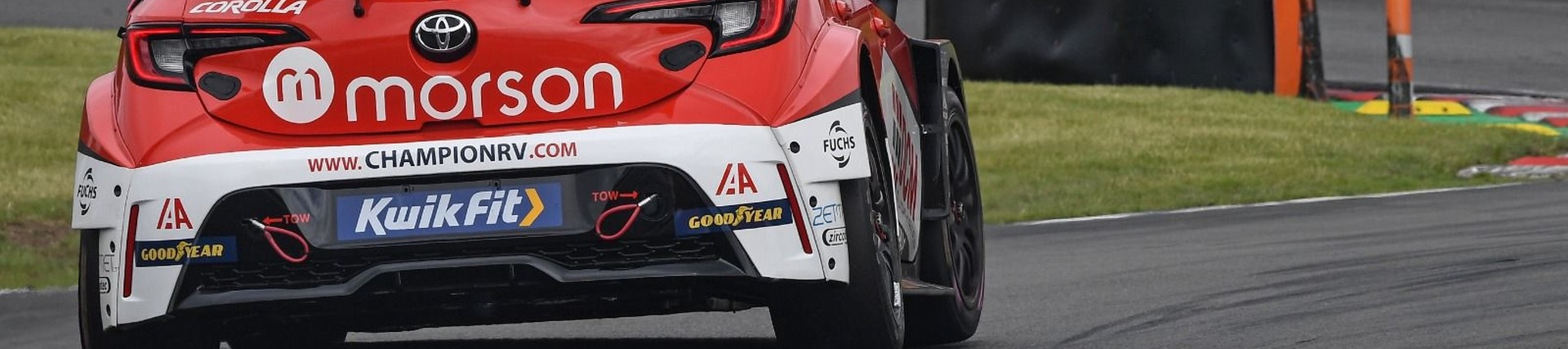
Beyond Data: Steve Brady on Trust, Translation and the Human Side of Motorsport Performance
Contents
- When Information Isn’t the Advantage
- Exclusive Access to Performance
- The Translator Between Instinct and Intelligence
- Why Trust Accelerates Performance
- The Competitive Advantage of Shared Understanding
- Learning Faster Than Everyone Else
- Finding Clarity Under Pressure
- Key Takeaways
- Beyond Motorsport
- Building Winning Teams at Morson Group
Contents
How the relationship between driver and engineer reveals the real secret behind elite performance.

When Information Isn’t the Advantage
In modern motorsport, data is everywhere. Every lap generates thousands of data points. Every corner, braking zone and steering input can be analysed, measured and compared.
Yet despite having access to more information than ever before, the difference between winning and losing often comes down to something far less tangible: trust.
For Steve Brady, race engineer at MB Motorsport and Speedworks Motorsport, elite performance isn’t about choosing between instinct and information. It’s about creating a partnership where both can thrive.
“You can make a very fast car that the driver can’t drive. It’s not a lot of use to us, so you have to merge the two together. My job is to merge it together.”
That simple observation captures a challenge increasingly facing organisations across every sector. Technology can provide insight. Data can provide answers. But performance ultimately depends on people knowing how to interpret, challenge and act on that information.
Whether in motorsport, engineering, defence, rail or energy, success is rarely the product of individual brilliance. It emerges from relationships built on expertise, communication and trust.
Exclusive Access to Performance
In conversation with Morson, BTCC race winner Josh Cook and race engineer Steve Brady offered a rare glimpse into one of motorsport’s most important partnerships.
While drivers often receive the attention, race engineers sit at the centre of performance. They are responsible for interpreting complex technical information, understanding driver feedback and making decisions under immense time pressure.
Brady’s role is particularly revealing because it mirrors a challenge facing organisations throughout STEM industries. As data becomes more abundant and technology more sophisticated, the real competitive advantage lies with people who can translate information into action.
The conversation highlighted a principle that sits at the heart of both motorsport and workforce development: performance improves when expertise is shared rather than siloed.
The Translator Between Instinct and Intelligence
Ask most people what a race engineer does and they’ll likely talk about telemetry, setup changes and technical analysis. Brady sees it differently:
“It’s, relaying what the driver can explain to me what he’s doing on track into the little squiggly lines I see to determine what the car is doing at that particular moment in time.”
The challenge is not simply understanding the numbers. The challenge is understanding the person generating them. Drivers experience a car through feel, instinct and experience, whilst engineers experience it through data. Neither perspective tells the whole story.
“I’m a translator in driver to data and then get the most out of what they can translate onto the car.”
The ability to translate between different perspectives is becoming one of the defining leadership skills of the modern workplace. Organisations increasingly need professionals who can bridge the gap between technical expertise and operational reality, between strategy and execution, between information and action.
Cook recognises exactly how valuable that partnership is:
“It’s very much a partnership with the engineering team. I am under no illusion that my engineer has more in-depth knowledge and more experience on chassis setup than what I have.”
That level of mutual respect creates an environment where expertise can be shared rather than protected.
Research from Harvard Business School has consistently found that high-performing teams benefit from diverse expertise combined with open communication, allowing individuals to contribute their specialist knowledge without hierarchy becoming a barrier to collaboration.
The lesson for organisations is clear. The best teams don’t compete internally for ownership of decisions. They combine expertise to arrive at better outcomes.
Why Trust Accelerates Performance
Technical expertise might build a competitive car, but trust is what unlocks its potential. For Brady, trust is something earned through experience:
“It takes a number of years working with them. It’s actually my second year with Gordon. He has a lot of trust in me now.”
That trust develops through shared challenges, difficult weekends and repeated problem-solving.
“You start to build a trust and a working relationship, and that’s really important.”
Cook describes the same process from the driver’s perspective:
“Of course the engineer’s goal is to try and get the driver to buy into what they’re doing but it’s more of a discussion and we come to a conclusion based on logical thinking rather than emotional.”
That distinction matters. In high-performance environments, decisions cannot be driven by ego, hierarchy or emotion. They must be driven by evidence, expertise and a willingness to challenge assumptions.
Cook continues:
“As long as we reach the conclusion logically and we go through the steps to get there then I’m comfortable with all the changes that makes the car.”
The principle applies equally to leadership teams, project environments and workforce planning. People commit to decisions more readily when they understand how those decisions were reached. Trust is not built through authority. It is built through transparency.
The Competitive Advantage of Shared Understanding
One of the most revealing moments in the conversation came when Cook explained why his engineering background strengthens his relationship with Brady.
“One of the things I’ve got to my advantage is I’ve got a very mechanical background. I’ve got a degree in motorsport engineering. I’ve always built my own cars.”
That technical understanding helps eliminate friction:
“When we’re looking at diagnosing an issue we might have, I can correlate what a damaged or failing component can do to a car and it helps me link the two together very quickly, so we can shortcut any issues we have.”
In elite competition, reducing decision-making time creates a measurable advantage. Cook believes that shared language between driver and engineer accelerates performance:
“That means that I’ve got an understanding of what positive and negative certain setup changes can do, which again helps me and my engineer shortcut things when we need to.”
For employers, this offers a valuable lesson. The strongest teams are often those where individuals understand enough about adjacent disciplines to communicate effectively across boundaries.
In engineering, manufacturing and technology, innovation increasingly happens at the intersection of different specialisms. People who can connect expertise rather than simply possess it often create the greatest value.
Learning Faster Than Everyone Else
Motorsport’s pace leaves little room for complacency. The calendar moves quickly. Decisions have consequences. Mistakes are exposed immediately. Yet Brady believes setbacks can be more valuable than success:
“You enjoy the success, but the failures are the big learning curves.”
It’s a mindset shared by many elite performers. Winning provides validation. Failure provides information:
“Anything that goes wrong that you can get right the next time you make sure that doesn’t happen again.”
Research into high-performance cultures consistently shows that organisations improve fastest when mistakes are analysed rather than hidden. Continuous improvement depends on learning, adaptation and accountability.
For Brady, the challenge isn’t avoiding every mistake. The challenge is making sure the same mistake only happens once.
That philosophy translates directly into career development. The most successful professionals aren’t necessarily those who fail least. They’re often those who learn fastest.
Finding Clarity Under Pressure
Race weekends compress hundreds of decisions into a matter of hours. Deadlines are fixed, opportunities are fleeting and performance depends on extracting the right information quickly.
“We have no time for errors.”
“It’s just pushing forward all the time.”
One of Brady’s most revealing insights comes immediately after drivers leave the car:
“Whatever’s happened in the heat of the moment, the emotions come out. They’re either complaining or they’re really happy. One way or another I need to get through that to the core information.”
This is leadership in its purest form. High-performing leaders acknowledge emotion without allowing it to cloud judgement. They listen carefully, identify what matters and focus attention on the information that drives better decisions.
Brady must simultaneously diagnose problems, coordinate mechanics and plan improvements:
“You need to balance what they can do to get you out on the race, plus what makes you faster. And that becomes the trickiest part of mine.”
That balancing act will feel familiar to anyone responsible for managing projects, teams or organisations. The challenge is rarely deciding between right and wrong, it’s deciding between what needs attention now and what creates long-term improvement.
Key Takeaways
- Combine expertise rather than competing for ownership of decisions.
- Build trust before pressure arrives.
- Create environments where evidence outweighs emotion.
- Develop a shared language across teams and disciplines.
- Use failure as a source of information rather than blame.
- Focus on translating insight into action.
- Prioritise communication as highly as technical capability.
Beyond Motorsport
While Brady’s work happens at 120mph, the principles behind it are becoming increasingly relevant across every industry.
As organisations adopt AI, automation and advanced analytics, the challenge shifts from gathering information to interpreting it effectively. The future belongs to teams capable of combining human judgement with technological intelligence.
Motorsport has always been a proving ground for innovation. Increasingly, however, its most valuable lessons are not technical but behavioural.
Trust, communication, learning and translation are the qualities that continue to separate high-performing teams from the rest.
Building Winning Teams at Morson Group
The relationship between Steve Brady and Josh Cook demonstrates a principle that sits at the heart of Morson’s approach to talent and workforce development: sustainable performance comes from combining expertise, trust and shared purpose.
Just as Brady translates driver feedback into actionable performance improvements, Morson helps organisations connect talent, capability and opportunity across some of the world’s most complex industries.
From aerospace and defence to energy, rail, engineering and technology, we help businesses build workforces capable of delivering under pressure while creating environments where people can thrive.
For employers, that means strategic workforce planning, STEM talent development and access to highly skilled professionals.
For candidates, it means long-term career support, opportunities for growth and connections to organisations where their expertise can make an impact.
The best teams don’t simply hire talent. They create partnerships that unlock performance.
Ready to accelerate your career or strengthen your workforce? Explore opportunities at www.morson.com/jobs and discover how the right people, working together, can achieve extraordinary results.
Contents
- When Information Isn’t the Advantage
- Exclusive Access to Performance
- The Translator Between Instinct and Intelligence
- Why Trust Accelerates Performance
- The Competitive Advantage of Shared Understanding
- Learning Faster Than Everyone Else
- Finding Clarity Under Pressure
- Key Takeaways
- Beyond Motorsport
- Building Winning Teams at Morson Group


